


Multi-Drop Bus Protocol | Intelligent Vending - Blog
Intelligent Vending Ltd >> Blog
April 2, 2025 – 7pm
Our Journey: From Traditional Vending Supplier to Innovative Solution Provider
Our story begins back in 2005. We started as a traditional vending equipment supplier, quickly gaining visibility through a website that ranked highly on search engines, attracting major clients seeking to leverage automation. But these weren’t requests for standard machines; blue-chip companies sought advanced, connected solutions to automate complex processes.
Initially, we worked with off-the-shelf machines and third-party components available in the standard vending marketplace. The limitations quickly became apparent. Industry protocols like MDB and Exec were never designed for deep integration or altering core process flows. This was starkly highlighted during a project for one of the top 3 global software companies at the time. We delivered what was then a state-of-the-art solution using the best available machines and bolt-ons from the industry. While appreciative, a Director candidly shared their view: as an innovative software company, they couldn’t believe how “Boring, Dull and Outdated” (his exact words!) the underlying technology of the vending industry was.
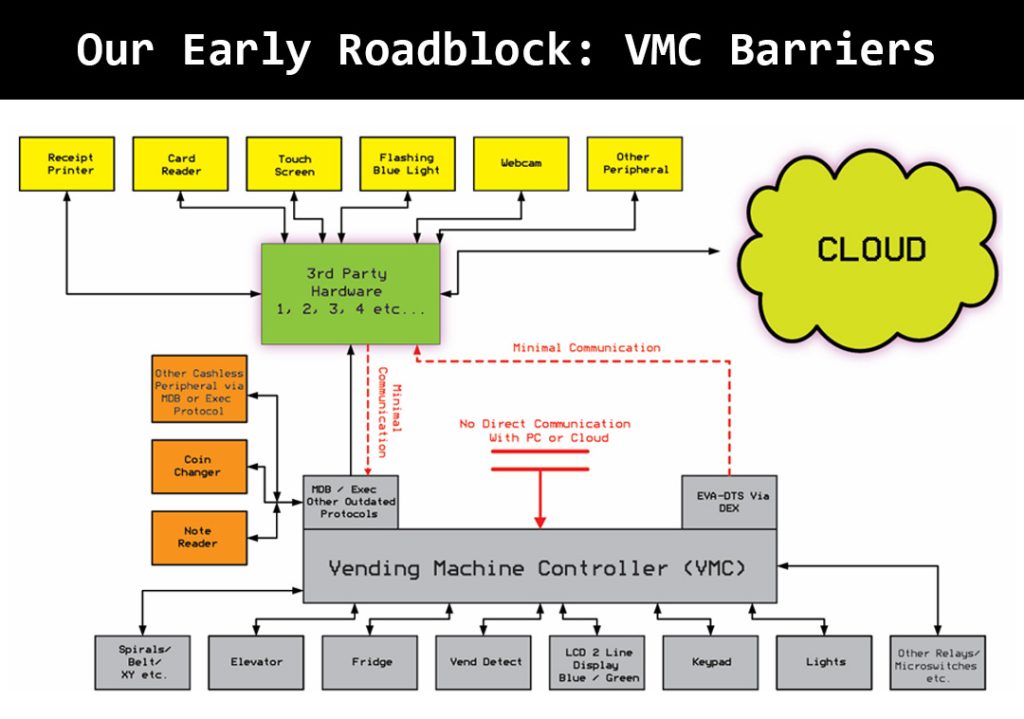
That blunt feedback reinforced the need to push beyond standard limitations. This led to our next phase: developing complex, bespoke electronics and software ‘bolted on’ to meet specific client needs. As a lean, agile team, we delivered some fantastic, targeted projects this way, often operating effectively under the radar within specific industry niches. However, this approach inherently lacked scalability and flexibility. Each solution was specific, making upgrades complex and costly – PCBs designed for one purpose couldn’t easily evolve.
The Turning Point: A Lost Opportunity Sparks Enduring Innovation
A pivotal moment came after working with a major overseas client on a potentially market-leading product concept, a strong relationship that had been established over a couple of years. The project ultimately failed when last-minute regulation changes, mandated by the local government for unattended equipment, introduced requirements that were technically impossible to implement using a bolt-on or ‘fudge-based’ control approach. This significant setback forced a fundamental rethink. Relying on patching existing, limited technology was clearly not a sustainable path forward.
The Birth of Quros®: Designing for Control, Flexibility, and the Future
We went back to the drawing board, deciding to invest strategically in designing our own core control platform from the ground up. We envisioned an IoT-based architecture, developing our own robotics controller to remove the reliance on restrictive industry VMCs (Vending Machine Controllers), paired with a software platform deployable locally but controllable bi-directionally, in real-time, from either the device or the cloud.
This vision, born from necessity and validated by real-world client challenges, has been sustainably developed from our base in the UK and meticulously refined over 15 years into what Quros® is today: A powerful, adaptable control platform built with core goals in mind:
- Rapid Development: Quickly configure and deploy complex solutions.
- Integration Ready: Architecture built to seamlessly connect with diverse systems and hardware.
- Future Expansion: Easily evolve and add capabilities over time.
While we are deeply involved with hardware – we appreciate the engineering, but we are not strictly manufacturers! Nevertheless, we are happy to handle CAD design, optimisation, and implementing improvements, and we thrive on deep technical engagement with dispense, robotics, and automated equipment. We realised early on (when pitching raw controllers, cables, PCs, and touch screens was met with blank stares in the traditional vending world) that we needed to demonstrate our platform’s power within a tangible solution.
Through various iterations over the years, our solutions have evolved, and this is where products like our latest Titan™ machine come in. Titan™ is a prime example of a hardware and software solution, built to our exacting specifications, showcasing the capabilities of the Quros® platform. It allows us to deliver a complete, advanced solution quickly.
Hardware is just a vehicle for Quros®, not our identity.
Quros®: The Platform Powering Your Next Innovation
At its heart, Quros® is the intelligent engine. It is a foundation that can power various types of self-service equipment – kiosks, vending machines, cabinets, and bespoke automated self-service solutions. It manages complex processes and enables real-time control and data insights far beyond traditional limitations.
We are not sheet metalworkers or traditional manufacturers. We are technology partners, focused purely on providing the core control intelligence that enables next-generation automation and engaging UX. Whether this is through hardware & software turnkey solutions, or OEM software solutions, we can assist.
An Invitation to Manufacturers and Innovators
If you are a hardware manufacturer looking to:
- Accelerate your R&D cycle with software
- Reduce development costs for advanced control systems
- Integrate cutting-edge IoT capabilities into your equipment
- Offer more flexible, powerful, and future-proof solutions to your clients
…then let’s talk. By integrating the Quros® platform, you can leverage our focused expertise and leapfrog significant development hurdles, bringing sophisticated, connected products to market faster and cheaper. We provide the proven control platform; you provide the specialised hardware. As a dedicated technology partner, we bring agility and deep system knowledge to the table.
Together, we can build the next generation of intelligent automated equipment.
Reach out to sales@quros.io learn more about how Quros® can power your innovation.
Posted in: A need for change, Access Control, Automated Sector, Control Boards, Corporate Solutions, Customised Vending, Customised Vending Machines, Digital Out of Home, Intelligent Vending, Intelligent Vending Ltd, International Supply, IoT Software, IT Peripheral Distribution, IT Solution, IT Vending Machine, Juno, Legacy Technology, Marketing & Promotion, MDB protocol, Multi-Drop Bus Protocol, Next Generation Vending Machines, OEM, Payment Peripherals and Accessories, Payment Systems, PC Controlled Vending Machines, Product and consumables, Product Help & Advice, Product News, Promotional Campaigns, Public Vending, Quros.io, Quros®, Research & Development, Retail, Sampling, Sampling Vending Machines, SandenVendo, Secure Distribution, Sexual Health Vending, Smart vending machine solutions, Smart Vending Machines, Stationery Vending Machines, Technology, Titan Touch Screen Machines, touch screen vending machines, VendHive, VendHook, Vending Help & Advice, Vending History, Vending Machine Communication Protocol, Vending Machine News, Vending Overseas, Vending Service, VendMesh, VMC, Wow factor!
Tags: AgileDevelopment, Automation, ControlPlatform, EmbeddedSystems, FutureProof, HardwareIntegration, Innovation, IntelligentVending, iot, Manufacturing, OEM, Quros®, R&D, SoftwareSolutions, SustainableGrowth, VendingTechnology
February 21, 2025 – 12pm
Understanding the MDB Protocol and Its Challenges in Modern Vending
The Multi-Drop Bus (MDB) protocol was established as a standard to unify communication between vending machines and peripheral devices, such as coin acceptors and bill validators. Its primary goal was to ensure interoperability across manufacturers by providing a common communication method in the vending industry. However, despite its widespread adoption, MDB was not designed with modern IT systems in mind, leading to significant challenges when integrating it with contemporary software and hardware platforms.
What the MDB Specification Aimed to Achieve
MDB was introduced to provide a structured, uniform communication protocol for vending machines. It standardised how machines interacted with payment devices and other peripherals, reducing proprietary incompatibilities across the industry. This allowed vending operators to mix and match different hardware components without requiring customised solutions. The protocol is a master-slave system, where the Vending Machine Controller (VMC) acts as the master, communicating with devices like coin mechanisms and other peripherals as slaves.
The Role of Cash in MDB’s Design
MDB was originally designed with cash transactions in mind, focusing on secure and efficient communication between vending machines and coin or bill validators. Cash was the main focus when the protocol was conceived. It is only in recent years that cashless payments have become increasingly important, prompting retrofitted support within the MDB framework. This shift towards cashless systems has introduced various complexities, including handling encryption, transaction verification, and real-time bi-directional communication with payment systems using flows and features for which the MDB specification was not originally designed.
Core Hardware and Interface Requirements
MDB operates using a serial communication bus with specific hardware requirements. Key technical details include:
- Baud Rate: Fixed at 9600 baud, which is relatively slow by modern standards but sufficient for vending operations.
- Data Format: Uses a 9-bit data frame, where the ninth bit is used to differentiate between address and data bytes.
- Electrical Characteristics: Operates on a 24V DC system, ensuring reliable power delivery to peripheral devices.
- Connector Type: A standard Molex Mini-Fit Jr 6 Way 2 Row 6-pin interface for MDB communication, including power, ground, and data lines.
- Polling Mechanism: The VMC continuously polls slave devices to request data and issue commands, ensuring synchronous operation.
The Compatibility Challenges of MDB
One of the core limitations of the MDB specification is its incompatibility with modern IT-based systems and programming languages. Unlike more flexible network-based protocols used in IoT and cloud systems, MDB requires specific hardware interfaces to function correctly. This reliance on dedicated serial communication hardware makes integration with standard computing environments cumbersome, as traditionally and historically, most communication was intended at a PCB level via firmware rather than modern PC-based languages.
Additionally, MDB has inconsistencies across different vending machine manufacturers. Certain features may work on one machine but fail on another due to variations in how the specification was interpreted. While some discrepancies arise due to hardware age and MDB version, others stem from manufacturer-specific implementations that deviate from the standard. These inconsistencies make it difficult to develop universal software solutions that work across all MDB-enabled machines, and thorough testing is required on different models to ensure reliability.
MDB’s Legacy in Cash-Based Systems
Another key issue with MDB is its origin as a protocol designed exclusively for cash-based vending transactions. While the vending industry has since shifted towards cashless payments, mobile transactions, and smart device integration, MDB remains constrained by its original framework. Cashless implementations have been retrofitted into the protocol over the years, but this adaptation has led to inefficiencies and added complexity in system integration. Devices requiring greater control and bi-directional communication often face limitations due to MDB’s structure, which is why specific integrations from PC to payment devices using their own native protocols are often preferred – they provide more control, faster transactions, and improved data and overall payment functionality and flexibility.
Advancements in MDB 4.3 and Remaining Challenges
MDB 4.3 introduced several enhancements to modernise the protocol, including:
- Remote Vending Capability: Allowing users to purchase items via mobile applications.
- Basket Transactions and Partial Refunds: Supporting multiple-item purchases and automatic refunds.
- Digital Coupon Acceptance: Enabling promotions and customer engagement strategies.
- Improved Cashless Transaction Handling: Enhancing communication between the vending machine and cashless payment devices.
While these improvements address some of MDB’s legacy limitations, the protocol still presents challenges for modern software developers. The fundamental architecture of MDB remains outdated compared to contemporary API-driven systems. Integration often requires additional hardware converters and middleware, adding complexity and cost to development efforts.
The latest documentation for the MDB protocol can be downloaded from this link MDB 4.3 specification.
Quick Round-Up
The MDB protocol has served the vending industry well for decades, providing a standardised communication method for vending machines and peripheral devices. However, as vending technology evolves, MDB continues to show its age, particularly in modern software environments that favour cloud integration, IoT connectivity, and seamless cashless payment processing. While MDB 4.3 has introduced improvements, the protocol remains a challenge for developers working on next-generation vending solutions. As the industry moves forward, alternative communication standards and APIs will be required to bridge the gap between legacy vending systems and modern technology.
Posted in: Automated Sector, C2 Coin Changers, Card System, Control Boards, Customised Vending, Customised Vending Machines, Intelligent Vending, Intelligent Vending Ltd, International Supply, IoT Software, Legacy Technology, MDB protocol, Multi-Drop Bus Protocol, Next Generation Vending Machines, OEM, Payment Peripherals and Accessories, Payment Systems, PC Controlled Vending Machines, Product Help & Advice, Quros®, Research & Development, Smart vending machine solutions, Smart Vending Machines, Technology, Vending Help & Advice, Vending Machine Communication Protocol, Vending Service, VMC
Tags: Integrations, Intelligent Vending, Interfaces, MDB 4.3 protocol, Multi-drop-bus, R&D, Time for change, Vending Machine Communication


