


Juno | Intelligent Vending - Blog
Intelligent Vending Ltd >> Blog
April 2, 2025 – 7pm
Our Journey: From Traditional Vending Supplier to Innovative Solution Provider
Our story begins back in 2005. We started as a traditional vending equipment supplier, quickly gaining visibility through a website that ranked highly on search engines, attracting major clients seeking to leverage automation. But these weren’t requests for standard machines; blue-chip companies sought advanced, connected solutions to automate complex processes.
Initially, we worked with off-the-shelf machines and third-party components available in the standard vending marketplace. The limitations quickly became apparent. Industry protocols like MDB and Exec were never designed for deep integration or altering core process flows. This was starkly highlighted during a project for one of the top 3 global software companies at the time. We delivered what was then a state-of-the-art solution using the best available machines and bolt-ons from the industry. While appreciative, a Director candidly shared their view: as an innovative software company, they couldn’t believe how “Boring, Dull and Outdated” (his exact words!) the underlying technology of the vending industry was.
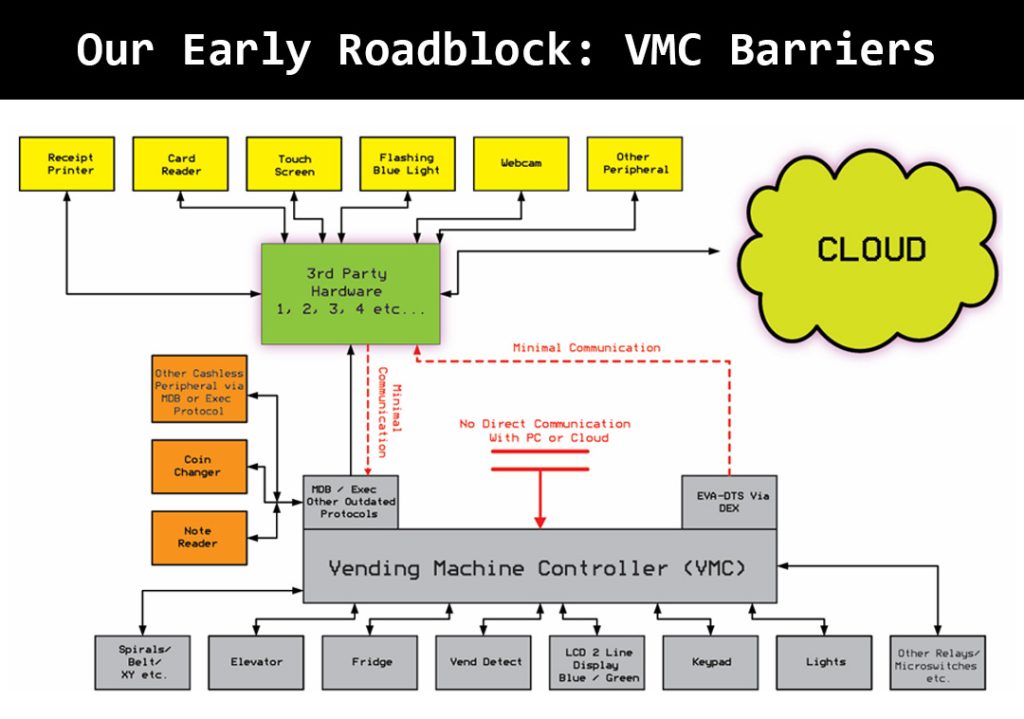
That blunt feedback reinforced the need to push beyond standard limitations. This led to our next phase: developing complex, bespoke electronics and software ‘bolted on’ to meet specific client needs. As a lean, agile team, we delivered some fantastic, targeted projects this way, often operating effectively under the radar within specific industry niches. However, this approach inherently lacked scalability and flexibility. Each solution was specific, making upgrades complex and costly – PCBs designed for one purpose couldn’t easily evolve.
The Turning Point: A Lost Opportunity Sparks Enduring Innovation
A pivotal moment came after working with a major overseas client on a potentially market-leading product concept, a strong relationship that had been established over a couple of years. The project ultimately failed when last-minute regulation changes, mandated by the local government for unattended equipment, introduced requirements that were technically impossible to implement using a bolt-on or ‘fudge-based’ control approach. This significant setback forced a fundamental rethink. Relying on patching existing, limited technology was clearly not a sustainable path forward.
The Birth of Quros®: Designing for Control, Flexibility, and the Future
We went back to the drawing board, deciding to invest strategically in designing our own core control platform from the ground up. We envisioned an IoT-based architecture, developing our own robotics controller to remove the reliance on restrictive industry VMCs (Vending Machine Controllers), paired with a software platform deployable locally but controllable bi-directionally, in real-time, from either the device or the cloud.
This vision, born from necessity and validated by real-world client challenges, has been sustainably developed from our base in the UK and meticulously refined over 15 years into what Quros® is today: A powerful, adaptable control platform built with core goals in mind:
- Rapid Development: Quickly configure and deploy complex solutions.
- Integration Ready: Architecture built to seamlessly connect with diverse systems and hardware.
- Future Expansion: Easily evolve and add capabilities over time.
While we are deeply involved with hardware – we appreciate the engineering, but we are not strictly manufacturers! Nevertheless, we are happy to handle CAD design, optimisation, and implementing improvements, and we thrive on deep technical engagement with dispense, robotics, and automated equipment. We realised early on (when pitching raw controllers, cables, PCs, and touch screens was met with blank stares in the traditional vending world) that we needed to demonstrate our platform’s power within a tangible solution.
Through various iterations over the years, our solutions have evolved, and this is where products like our latest Titan™ machine come in. Titan™ is a prime example of a hardware and software solution, built to our exacting specifications, showcasing the capabilities of the Quros® platform. It allows us to deliver a complete, advanced solution quickly.
Hardware is just a vehicle for Quros®, not our identity.
Quros®: The Platform Powering Your Next Innovation
At its heart, Quros® is the intelligent engine. It is a foundation that can power various types of self-service equipment – kiosks, vending machines, cabinets, and bespoke automated self-service solutions. It manages complex processes and enables real-time control and data insights far beyond traditional limitations.
We are not sheet metalworkers or traditional manufacturers. We are technology partners, focused purely on providing the core control intelligence that enables next-generation automation and engaging UX. Whether this is through hardware & software turnkey solutions, or OEM software solutions, we can assist.
An Invitation to Manufacturers and Innovators
If you are a hardware manufacturer looking to:
- Accelerate your R&D cycle with software
- Reduce development costs for advanced control systems
- Integrate cutting-edge IoT capabilities into your equipment
- Offer more flexible, powerful, and future-proof solutions to your clients
…then let’s talk. By integrating the Quros® platform, you can leverage our focused expertise and leapfrog significant development hurdles, bringing sophisticated, connected products to market faster and cheaper. We provide the proven control platform; you provide the specialised hardware. As a dedicated technology partner, we bring agility and deep system knowledge to the table.
Together, we can build the next generation of intelligent automated equipment.
Reach out to sales@quros.io learn more about how Quros® can power your innovation.
Posted in: A need for change, Access Control, Automated Sector, Control Boards, Corporate Solutions, Customised Vending, Customised Vending Machines, Digital Out of Home, Intelligent Vending, Intelligent Vending Ltd, International Supply, IoT Software, IT Peripheral Distribution, IT Solution, IT Vending Machine, Juno, Legacy Technology, Marketing & Promotion, MDB protocol, Multi-Drop Bus Protocol, Next Generation Vending Machines, OEM, Payment Peripherals and Accessories, Payment Systems, PC Controlled Vending Machines, Product and consumables, Product Help & Advice, Product News, Promotional Campaigns, Public Vending, Quros.io, Quros®, Research & Development, Retail, Sampling, Sampling Vending Machines, SandenVendo, Secure Distribution, Sexual Health Vending, Smart vending machine solutions, Smart Vending Machines, Stationery Vending Machines, Technology, Titan Touch Screen Machines, touch screen vending machines, VendHive, VendHook, Vending Help & Advice, Vending History, Vending Machine Communication Protocol, Vending Machine News, Vending Overseas, Vending Service, VendMesh, VMC, Wow factor!
Tags: AgileDevelopment, Automation, ControlPlatform, EmbeddedSystems, FutureProof, HardwareIntegration, Innovation, IntelligentVending, iot, Manufacturing, OEM, Quros®, R&D, SoftwareSolutions, SustainableGrowth, VendingTechnology
November 7, 2019 – 9am
Are the robots really coming?
At Intelligent Vending we are always really excited at the prospect of new technology. Having designed our own innovative control platform we have a great respect for the time and imagination and precision it takes to produce something truly cutting edge. People in the Western world, on the whole, have a remarkable fascination with technology, the latest phones are always sold out within the first 24 hours, the latest tablets and drones are always on top of Santa’s wish list and the advances in virtual reality and video consoles always leave us mind blown and wanting more. As much as we love our gadgets and crave the leaps, year on year, that technology makes there is also a slight unrest when it comes to views on technology. Dealing with a lot of technical enquiries through our Intelligent Vending switchboard, people are genuinely blown away with the functionalities that they can potentially harness with our SiriuS™ and Juno™ end to end solutions, but talking to people on a more day to day level, as much as they like technology to play with, there are slight misgivings that the more advanced we become, the more likely we are to become redundant as a race. It is the time old concern (film, literature and media fuelled!) that “The robots are coming” . We already use robots and machines in place of people for a large number of fields; the service sector, the entertainment sector, the industrial and auto-mobile sectors, these are all programmable and fully automated. From 2018- 2019, the robotics industry grew as a whole and it has been reported by the International Federation of Robotics (IFR) that the global robotics market rose to US$16.5 billion [1] in that time.
So how does a country like Japan, a pioneer in the technological world feel in regards to the slight nervousness we seem to possess in the West? In Japan, automation isn’t regarded as a threat to peoples jobs but more about the countries survival economically. In 2014 Prime Minister Shinzo Abe unveiled reforms with hopes that the robot market would reach $21 billion by 2020 [2] and looking at the stats published by the IFR, that seems well on track. Reading a recent article by CNBC [3], their reporters explored different areas of the service industry in Japan and watched the interaction between the robot world and the human one. It seems that in Tokyo, the public enjoyed the novelty that the robots provided, but in regards to their suitability to assist with their practical needs this didn’t seem particularly harnessed. Which raises the question, are they actually a source of entertainment? Could this be a more accurate interpretation of their function? Are we merely fearful of fear itself? Reporters from CNBC could witness robots being utilised whilst consumers were queuing, to pass the time while they waited to engage with a person.
The Japanese, on the whole, are renowned for being truly fascinated by technology and love the gimmicks and interaction that it provides. For me, this gave me a little sense of reflection and comfort. In the West, creating life inevitably leads to destruction of the creator (Frankenstein, The Terminator, The book of Exodus) it is suggested that human vanity is constantly met by rebellion by its creation [4]. There are many philosophies, predictions and conspiracy theories concerning the fate of our world, in films, literature and media and whether, with our thirst for and advancement in technology, we are actually pushing ourselves into economic and social extinction in an ‘End of Days’ scenario.
I never look upon technology as anything other than exciting and pioneering and I suppose that is also how the designers and manufacturers also view their robotic creations. Do I think “The robots are coming”? Yes, absolutely, in fact I think they are already here, but does that mean I think they are taking over? Hmmm… no…. not just yet, anyway.
Footnotes
[1] https://ifr.org/ifr-press-releases/news/presidents-report-03-2019
[2] https://www.cnbc.com/2017/03/09/heres-why-japan-is-obsessed-with-robots.html
[3] https://www.cnbc.com/2017/03/09/heres-why-japan-is-obsessed-with-robots.html
[4] https://s/421187/why-japanese-love-robots-and-americans-fear-them
References
1. https://www.cnbc.com/2017/03/09/heres-why-japan-is-obsessed-with-robots.htm
2. https://ifr-press-releases/news/presidents-report-03-2019
3. https:///23-reasons-why-japan-is-already-living-in-the-future
4. https://2017/11/16/asia/cea-tec-on-japan/index.html
5. https://s/421187/why-japanese-love-robots-and-americans-fear-them
Posted in: Automated Sector, Intelligent Vending, Intelligent Vending Ltd, Intelligent Wholesale, Juno, Next Generation Vending Machines, SiriuS, Technology, Vending Overseas
Tags: Cutting Edge Technology, Innovative Technology, Intelligent Vending, Intelligent Wholesale, Japanese Technology, Japanese Vending, Juno, SiriuS
November 1, 2019 – 2pm
The Magic of the Face
Facial recognition, also referred to as Biometric Artificial Intelligence, is regarded now as one of the top ways of identifying and verifying a person. It is so common place that we probably even have it in our homes, either through our consoles, phones or security systems. Growing up in the 80’s face recognition was something only for the James Bonds’ of this world, but the advances in the last decade alone have catapulted this incredible technology into the lives of us all. Facial recognition is already being harnessed by several industries; Law enforcement use it to serve and protect, retailers use it for crime prevention, Airports use it for security (and we even have the technology to use it on our Intelligent Vending machines, if clients desire it to deliver their project objectives! Wow!).
So where did all this catapulted technology come from? It’s true the last decade has really thrown facial recognition into the spotlight, but where did it start? Many believe that the 1960’s is where it all began with the work from Woodrow Wilson Bledsoe. Bledsoe was an American mathematician, computer scientist and prominent educator. Born in 1921, he is regarded as one of the founders of artificial intelligence, making early contributions in pattern recognition and automated theorem proving. His work in the 1960’s included developing a system that could classify photos of faces manually, known as the RAND tablet (considered the predecessor of the iPad, in many circles). The RAND could be used to input horizontal and vertical coordinates on a grid, using a stylus that emitted electromagnetic pulses, this in turn could manually record the coordinate locations of various facial features; these could then be added to a database and when the system was given a new photo of an individual it could retrieve the image that most resembled it. [1] The smart technology of the era being so limited meant that the advancement in facial recognition were restricted but never the less it is seen as an important step in proving that face recognition was a viable biometric.
In the 1970’s a more well known milestone in facial recognition, “21 facial markers” was devised by Goldstein, Harmon and Lesk. Using 21 specific subjective markers such as hair line, lip thickness and eye width they were able to increase accuracy to the (still manual) facial recognition system.
The 1980’s saw linear algebra being applied to the problem of facial recognition, this became known as the Eigenface approach. Scientists discovered they could accurately code a ‘normalised face’ in less than 100 values.
In the 1990’s the Eigenface approach was developed further and had been advanced to recognise faces within images. This was the first use of automatic facial recognition.
The following 20 years, has involved a lot of practical research and field tests including the Feret programme (creating a large database of facial images) and The Super Bowl, in the USA in 2002 where law enforcement trialed the technology, but were limited by its functionality in crowds. Facebook started using facial recognition in 2010 and continue to utilise it today along with Apple, Military and retail sectors.
So with all this incredible biometric technology all around us, should we be concerned at all? Is our privacy being compromised by the gathering of our own data through surveillance techniques or our phones when we are sometimes not even aware of it? Privacy campaigners express concern about governments and other authorities having access to the whereabouts, and activities of citizens 24/7, some of these concerns arise from biometric artificial intelligence being so advanced, it can be used to not just identify a person but show them other existing personal data like blog articles, photos, social networking profiles, internet searches etc. This can make the public vulnerable on a number of levels for example; your facial signature could end up in a lot of places, hackers may track down images of you (or your face) online, this data may be sold, people can be left open to online harassment, stalking and trolling. It is also becoming less and less impossible to remain anonymous. [2] As the digital age advances and the need for identification and authentication of a person continues to elevate, is it our face that is going to be the key to the future? To action the opening of a bank account we would use our face, or going through customs at an airport we would use our face, access and unlock technology (including cars!) with our face, even the potential of paying for goods, withdrawing your money from ATM’s and verifying your age (therefore completely abandoning the need for a wallet at all!) all because of the magic of your face! It seems there can be no denying this technology, despite any concerns we might have as it seems to be the top way to verify and authenticate. I guess there is nothing left to do except put our very best face forward.
Footnotes
[1] /blog/brief-history-of-face-recognition-software/
[2] internetsecurity-iot-how-facial-recognition-software-works.html
References
1. /internetsecurity-iot-how-facial-recognition-software-works.html
2. /innovation/facial-recognition-works.html
3. /blog/brief-history-of-face-recognition-software/
5. /wiki/Facial_recognition_system
6. /govt/biometrics/facial-recognition
7. /blog/rand-review/2018/09/the-rand-tablet-ipad-predecessor.html
Posted in: Customised Vending, Intelligent Vending, Intelligent Vending Ltd, Intelligent Wholesale, International Supply, IoT Software, Juno, Kiosks, Next Generation Vending Machines, PC Controlled Vending Machines, SiriuS, Technology, touch screen vending machines, Vending Help & Advice, Vending History
Tags: Facial Recognition, Intelligent Vending, Intelligent Wholesale, Juno, RAND, SiriuS, Technology, Technology History
October 9, 2019 – 5pm
Always safety first at Intelligent Vending!
A very exciting, very safety conscious area of our website has been developed to give you guys the very best access to safety equipment or Personal Protection Equipment (PPE) as it is known in the field.
PPE is an essential requirement for many companies, and is an important component of industrial vending as it provides staff with safety equipment to reduce the risk of occupational injury or harm.
Controlling the use of PPE within an industrial environment can prove to be a challenging task for companies. On the one hand, the potentially high volumes of kit required to meet the needs of a large workforce provide significant incentive to employers to manage stock as efficiently as possible, including reducing wastage. On the other, it is essential that employers do not expose their staff to unnecessary risk or deny access to equipment that provides employees the necessary protection for their day to day working environment.
The level of health and safety regulation covering such responsibilities means that in a typical workplace most companies ‘play safe’ by providing open and unsupervised access to items routinely used on the shop floor, e.g. gloves, goggles, ear protection etc. However, such arrangements create precisely the conditions where excessive usage is likely to occur.
The introduction of a PPE management system using vending equipment and sophisticated control software offers a cost effective and reliable solution to this problem; especially if the level of wastage is high and items needed for a particular work setting are expensive. Intelligent Vending offer a range of PPE vending machines, from retail only to standalone to fully integrated PPE management systems which can dramatically reduce or fully eliminate routine waste, while providing a detailed audit trail linked to individual users, including a full usage history. This means that every transaction with the machine is tracked 24/7 and reports can either by pre-scheduled or accessed manually on the fly.
For entry level PPE solutions we can provide hardware from our standard Intelligent Vending catalogue. However, standard machines offer a limited functionality, so most clients would opt for our advanced fully PC controlled Intelligent Vending machines (Juno™ 8 inch touch or SiriuS™ 46 inch touch) which are packed full of features and capabilities. We also supply MRiYA™ electronic cabinets that can be slaved and controlled from Juno™ and SiriuS™ machines. These are perfect for larger items not suited for physical dispense from Juno™ or SiriuS™ solutions. They also offer the potential for items to be loaned and returned.
Our rapid development platform also promotes comprehensive and coherent integration with client preferred hardware, software or peripherals and creates new ‘tailored’ solutions with significantly reduced R&D costs and in reduced timescales. The benefits to choosing our control platform are vast; the platform is a fully Internet of Things (IoT) based solution, providing two-way communication 24/7 in real time between our Juno™ or SiriuS™ machines and our VendHive™ cloud. This enables live transaction reporting and control of a wide variety of machine functions and settings, clients are provided with detailed logging in real time for immediate identification and diagnosis of faults, any software issues are usually rectifiable remotely and for mechanical issues, an engineer would be alerted to the nature of any mechanical fault before leaving base, avoiding the need for re-visits and saving time and money.
The intelligence of our PC controlled PPE solutions reduce downtime, as many issues that would cause out of order scenarios can be adapted to automatically. Our system can also identify under-usage of equipment as well as potential overuse, a further element of support to employers who need to be made aware if workers are not taking advantage of measures in place to ensure their own safety. Touch screens coming as standard on Juno™ and SiriuS™ also enables the display of detailed product information and videos. This could easily be adapted to include showing staff how equipment should be used, whilst providing an efficient audit trail to show the information has been viewed through user confirmation, this feature is also applicable to any new H&S procedures; thereby providing evidence for employers that they are meeting their responsibilities.
Our user interfaces are intuitive and easy to use, both by the users requiring access to items and staff responsible for day to day management of the equipment and even the ‘standard’ generic interfaces offer a high degree of customisation, while for more demanding or sophisticated applications we can supply a fully bespoke solution. This includes a user journey that is tailored to our clients’ specific requirements, displaying all information as appropriate for their organisation. The potential is huge and the list goes on! If PPE is something you need managing effectively in your business, there is only one intelligent choice, check out our PPE vending machines!
Posted in: Customised Vending, Health and Safety, Intelligent Vending, Intelligent Vending Ltd, Intelligent Wholesale, International Supply, IoT Software, Juno, Medical Distribution, PC Controlled Vending Machines, PPE, PPE and Industrial Vending, PPE Distribution, Product Help & Advice, SiriuS, Technology, touch screen vending machines, Vending Help & Advice, Vending Service
Tags: Health and Safety, Industrial Vending, Intelligent Vending, Intelligent Wholesale, Juno, Personal Protection Equipment, ppe, Safety Equipment, SiriuS
March 22, 2019 – 9am
Intelligent Wholesale has arrived
Intelligent Wholesale is finally here. This is the business-to-business ecommerce trading division of Intelligent Vending. Our fantastic new homepage clearly showcases the most popular categories making it easy to navigate and operate. The highlighted deals are easily accessible as you scroll down the page and be sure not to miss out on our regular informative and inciteful blogs. At Intelligent Vending we believe our website to be an ever growing, ever evolving, living, breathing catalogue of choice. With this in mind an exciting addition to the website is on the horizon. It will be accessible on the website through our technology centre. This is where we showcase our in-house designed, next generation of automated retail. We will be soon be presenting more of our latest technology with traditional high-quality engineering…. but that’s all for now… Better watch this space
Posted in: Air Freshener, Air Steriliser, Automated Sector, Change Machine and Token Dispensing, Condom Vending Machines, Currenza C2 Coin Changers, Customised Vending, Flavia ®, Fly Killers, Hand Dryer, Health and Hygiene, Hospitality and Leisure sectors, Intelligent Vending, Intelligent Vending Ltd, Intelligent Wholesale, International Supply, Juno, Kenco, Kiosks, Magnum, Next Generation Vending Machines, Payment Peripherals and Accessories, Payment Systems, Product and consumables, Product Help & Advice, Product News, Recycling Vending Machines, Sexual Health Vending, Technology, touch screen vending machines, Valera, Vending Help & Advice, Vending Machine News, Washroom Accessories, washroom vending, Watercoolers
Tags: automated dispense machines, blog articles, Borg & Overström, change machines, Coin and Token Dispensing Machines, Commercial Washroom, flavia, Fly Killers, Hand Dryers, Hospitality and Leisure, Ingredients and Consumables, Intelligent Vending Ltd, Intelligent Wholesale, IT Peripherals, kenco, Magnum, next generation vending machines, Payment and Telemetry Solutions, ppe, Salon, Solis, Swiss Hair Dryers, Unattended IoT Solutions, Unicorn Hygienics, valera, washroom vending, Water Cooler


